How to write your wedding vows with clarity and heart
A refined, practical guide to writing wedding vows that feel personal, honest, and beautifully spoken on the day they matter most.
How to write your wedding vows without losing your voice
Knowing how to write your wedding vows is less about sounding poetic and more about sounding true. The best vows do not try to perform the relationship, they reveal it. They sound like one partner speaking directly to another, with enough honesty to feel specific and enough care to feel lasting.
That can be harder than it looks. Many people sit down to write and immediately feel pressure. They worry the words must be extraordinary, deeply original, and worthy of a ceremony. In reality, the most moving vows usually come from a simpler place. They notice what has actually mattered: the ordinary loyalty, the steady humour, the difficult seasons, the small habits of care, the life the couple has already started to build.
As one old line puts it,
“The best thing to hold onto in life is each other.”
That is not a template, but it is a useful reminder. Vows are not a speech contest. They are a public promise shaped by private history. If you write them with clarity, restraint, and a little courage, they can become one of the most memorable parts of the day.
Start with what is already true
The most reliable way to begin is to stop thinking about elegance and start thinking about evidence. What has this relationship taught you? What do you know now, after living alongside this person, that you did not know at the start?
Before you write a single polished sentence, make a private list. Do not edit yourself. Write the small things and the large things.
- The moment you knew this relationship was serious
- The habits that make daily life easier together
- The hard season you got through together
- The quality you admire most in your partner
- The promise you are actually ready to make
This list matters because it keeps your vows grounded. For example, “You make me laugh” is pleasant but vague. “You make me laugh when I am being too serious about a problem that will not matter next week” reveals a real pattern in the relationship. Specificity gives vows their weight.
If you are writing how to write your wedding vows for a second marriage, a long engagement, or a relationship that has already weathered challenge, the same principle applies. Speak to what has been lived, not what is expected. That is where dignity lives.
Use a simple structure that feels natural
Beautiful vows often have structure, even when they sound effortless. You do not need a formula, but you do need a path from memory to promise. A clear shape will keep you from rambling and help the words land.
A clean vow structure to follow
- Open with one or two honest lines about what this person means to you.
- Reflect on a shared memory, pattern, or season that has shaped the relationship.
- Say what you admire and why it matters.
- Make your promises in plain language.
- Close with a line that feels personal, restrained, and memorable.
You might think of it like this: affection, evidence, promise, closure. That sequence works because it mirrors how people actually connect. We are moved first by feeling, then by recognition, then by commitment.
One of the most useful lines you can ask yourself is, “What am I promising that I can truly keep?” Vows should not sound heroic. They should sound dependable.
“Love does not consist in gazing at each other, but in looking outward together in the same direction.”
That quote is often remembered because it captures a marriage truth many couples come to understand with time. The ceremony matters, but the life beyond it matters more. Your vows should point toward that life.
How to write your wedding vows with honesty and restraint
When people ask how to write your wedding vows, they are often really asking how to sound romantic without becoming theatrical. The answer is restraint. Not coldness, not distance, but careful editing. Keep what is alive. Let go of anything that sounds borrowed.
Say less, then say the right thing
A vow does not need to catalogue every chapter of your relationship. In fact, too much detail can flatten the emotional line. Select one or two memories that carry symbolic weight. For instance, if your early days involved a long-distance commute, that may say more about perseverance than a dozen generic lines about destiny.
Here is the difference:
- Vague: “You complete me in every way.”
- Stronger: “You make my life steadier, kinder, and more honest.”
The second line is more believable because it names what marriage often does in practice. It does not inflate the relationship. It respects it.
Avoid promises you cannot control
There is a quiet dignity in making promises that are human-sized. Rather than pledging endless perfection, promise attention, patience, steadiness, or effort. These are things a partner can feel over time.
Consider the difference between these two versions:
- “I will always make you happy.”
- “I will keep learning how to love you well, especially when life is busy, ordinary, or uncertain.”
The second is better because it allows for real life. Marriage includes calendars, tiredness, career changes, family obligations, illness, and bills. Elegant vows do not deny any of that. They simply promise presence inside it.
“A good marriage is one which allows for change and growth in the individuals and in the way they express their love.”
That idea is especially helpful if you are writing vows after years together. You are not promising to freeze each other in the version you know today. You are promising to remain attentive as both of you continue to change.
Write for the ear, not just the page
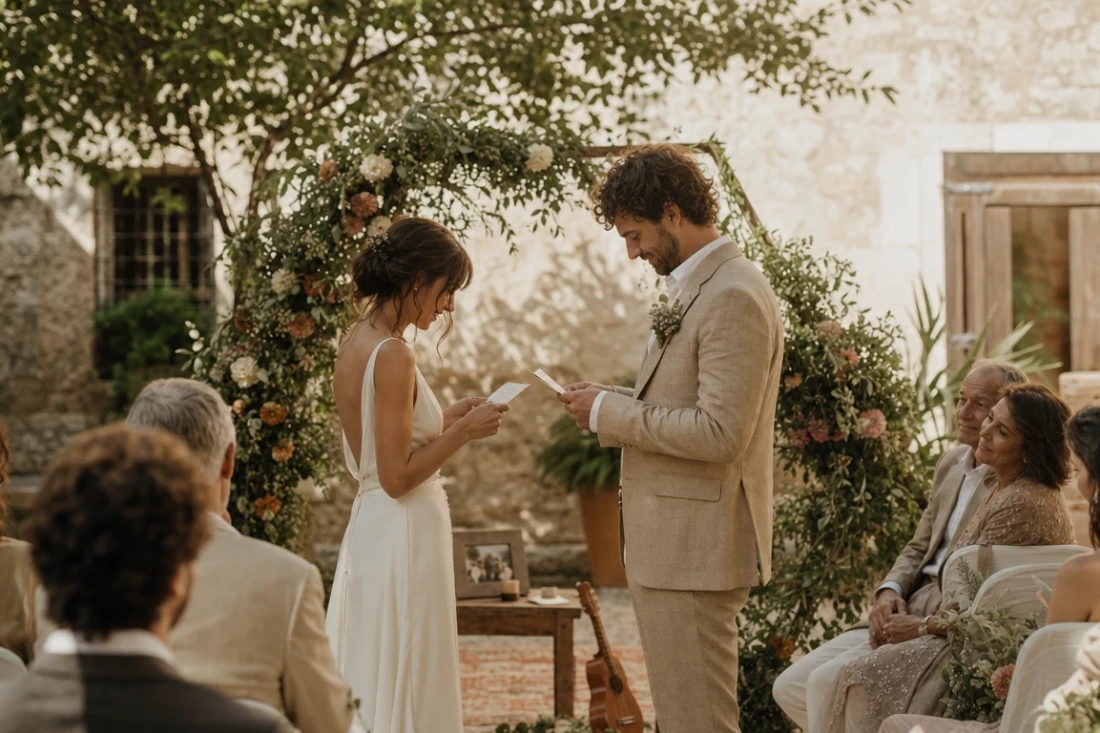
Wedding vows are meant to be spoken aloud. That means rhythm matters. Short sentences can carry feeling better than long, elaborate ones. A clean vow often sounds more powerful in the room because it gives listeners, and the speaker, space to breathe.
Read your draft out loud several times. You will immediately hear where the sentence is too long, where the wording is stiff, and where the language feels borrowed from somewhere else. What looks graceful on a page can sound formal or unnatural in a ceremony.
Practical examples of stronger wording
Try these adjustments:
- Replace “I am eternally grateful” with “I am grateful, every day, for the life we are building.”
- Replace “You are my soulmate” with “You are the person I choose, again and again.”
- Replace “You have changed me forever” with “You have made me more patient, more open, and more myself.”
Those phrases are not less loving. They are simply more precise. Precision is often what makes vows feel sincere rather than inflated.
If you are nervous about speaking, write the vows in a font that is easy to read and leave generous spacing. This is not a small detail. In the ceremony itself, calm delivery matters almost as much as the words.
What to include, and what to leave out
A vow is a concentrated form. It is not a thank-you speech, a biography, or a private joke transcribed for guests. When couples struggle with how to write your wedding vows, it is often because the piece is trying to do too much at once.
Include these elements
- A clear opening that names your partner or your bond
- A memory or detail that belongs only to the two of you
- A quality you deeply respect
- A promise expressed in ordinary language
- A closing line that feels calm and intentional
Leave these elements out, or keep them brief
- Inside jokes that no one else will understand
- Long apologies, unless they are truly necessary and carefully phrased
- Humour that could embarrass your partner
- Grand claims that sound impressive but hollow
- Too many references to social media, trends, or borrowed phrases
If a line would sound awkward when repeated years later, consider leaving it out. The most timeless vows still make sense after the wedding flowers have faded and the photographs are framed.
“I have found the one whom my soul loves.”
Simple lines like that endure because they do not chase originality. They trust emotional truth.
Examples of vows that feel modern and enduring
Sometimes the blank page remains stubborn until you see a model. Below are a few brief examples in different tones. Use them as inspiration, not as scripts.
A steady and understated example
I choose you as my partner, my home base, and my closest companion. I promise to meet you with honesty, to listen before I react, and to keep making a life with you that is generous, thoughtful, and real. I will stand with you in the easy seasons and the difficult ones, and I will keep learning how to love you with more care each year.
A warmer, more intimate example
You know the parts of me that are polished and the parts that are not, and you have stayed kind through both. I promise to protect the softness between us, to laugh with you when life is light, and to be patient when life is heavy. I will keep choosing our life, not because it is perfect, but because it is ours.
A concise example for someone who prefers restraint
I promise to be your calm, your witness, and your companion. I will treat our life together with care, speak truthfully, and keep showing up with love that is practical as well as tender. Today and in the years ahead, I choose you.
Notice how each example avoids excess. None of them tries to sound larger than life. They sound like commitments made by adults who understand that love is also a practice.
How to revise your vows without overworking them
Revision is where many people lose the natural quality of their writing. They keep polishing until the vows sound generic or over-scripted. Edit with a light hand. You are looking for clarity, not perfection.
- Cut any sentence that repeats an earlier idea.
- Replace abstract words with concrete ones where possible.
- Remove filler phrases like “from the bottom of my heart” if the line already says enough.
- Keep the strongest promise near the end.
- Make sure the final sentence is easy to speak without rushing.
It can help to set the draft aside overnight, then return to it as if you were someone who loves the person but did not write the piece. That small distance often reveals what truly matters.
If you are wondering whether your vows are “good enough,” ask a better question: do they sound like me, and do they honour us? If the answer is yes, they are ready.
A grounded way to finish
Learning how to write your wedding vows is really an exercise in discernment. You are deciding what to keep, what to leave unsaid, and what promise is worth carrying into married life. The most beautiful vows rarely impress by scale. They stay with people because they feel composed, honest, and human.
Write from memory. Edit for clarity. Speak in a way your future self will still respect. If your vows are modest but sincere, they will almost always age better than something ornate that was written to impress the room.
In the end, the right words are not the most dazzling ones. They are the ones that hold steady.
“To love and be loved is to feel the sun from both sides.”
Use that as a final reminder, not a slogan. Your vows do not need to describe every feeling in the room. They only need to make a promise you can mean, aloud, in front of the person you have chosen.
Frequently asked questions
How long should wedding vows be?
Most wedding vows work well at about one to three minutes each, depending on the ceremony style. Shorter vows can feel elegant and focused, while longer vows should still stay clear and easy to follow.
How do I write wedding vows if I am not a natural writer?
Start with simple notes about your partner, your relationship, and the promises you can truly make. Speak in plain language, then read the draft aloud and remove anything that sounds forced or overly formal.
Can I use humor when I write my wedding vows?
Yes, but keep it gentle and specific to your relationship. A small, affectionate line can work well, as long as it does not embarrass your partner or distract from the seriousness of the promise.
What should I avoid when writing wedding vows?
Avoid vague clichés, exaggerated promises, inside jokes that no one else will understand, and anything that could feel awkward years later. Keep the focus on sincere, realistic commitment.
How early should I start writing my wedding vows?
Start a few weeks before the wedding if possible. That gives you time to think, revise, and practice reading them aloud without the pressure of last-minute writing.
Team To Our Love: Our editorial team writes about relationships, love and the small, meaningful habits that keep two people close.